American Society MIcribiology. mBio 0:e03175-25.2025.
Nueva publicación: Influence of DNA methylation and chromatin accessibility on regulation of gene expression during Trichomonas vaginalis-host cell interaction.
Trichomonas vaginalis is a common sexually transmitted parasite that colonizes the human urogenital tract, causing infections that range from asymptomatic to highly inflammatory. As an extracellular pathogen, adherence to host epithelial cells is an important step to colonize the human host. Hence, understanding how the process of attachment to host cells is regulated remains an important goal in parasitology research and human health. T. vaginalis-host interaction is regulated by changes in gene expression, but it is still largely unknown how these changes in transcriptional profiles are controlled, as very few transcriptional regulatory elements have been described. Our recent work highlighted the importance of epigenetics in the regulation of transcrip-tion, and a specific role for N6-methyladenine (6mA) in modulating three-imensional chromatin structure has been suggested. Building on these findings, we analyzed here the role of 6mA and chromatin accessibility during the process of host-parasite interaction by integrating MeDIP-seq and assay for transposase-accessible chromatin sequencing data with RNA-seq in free vs host cell-attached parasites. Consistent with our previous results, we identified transcriptionally active and repressive regions flanked by 6mA modifications, observed both in the presence and absence of host cells. Impor-tantly, we detected differentially accessible chromatin regions that influence the gene expression of key pathogenesis-related genes during T. vaginalis host cell interaction. These findings highlight the importance of chromatin architecture in regulating gene expression during parasitic infection.
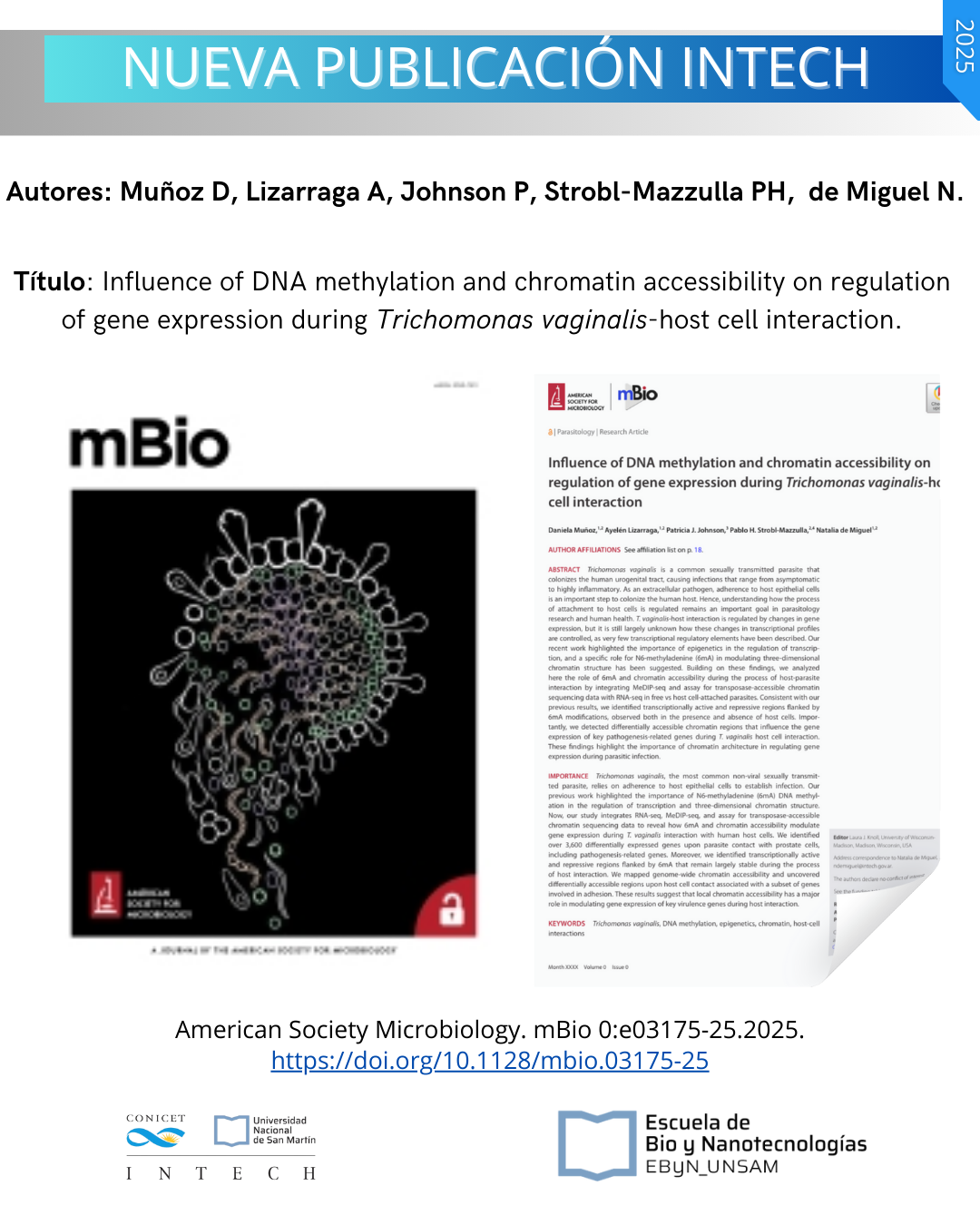
Muñoz D, Lizarraga A, Johnson P, Strobl-Mazzulla PH, de Miguel N. Influence of DNA methylation and chromatin accessibility on regulation of gene expression during Trichomonas vaginalis-host cell interaction. American Society MIcribiology. mBio 0:e03175-25.2025. https://doi.org/10.1128/mbio.03175-25