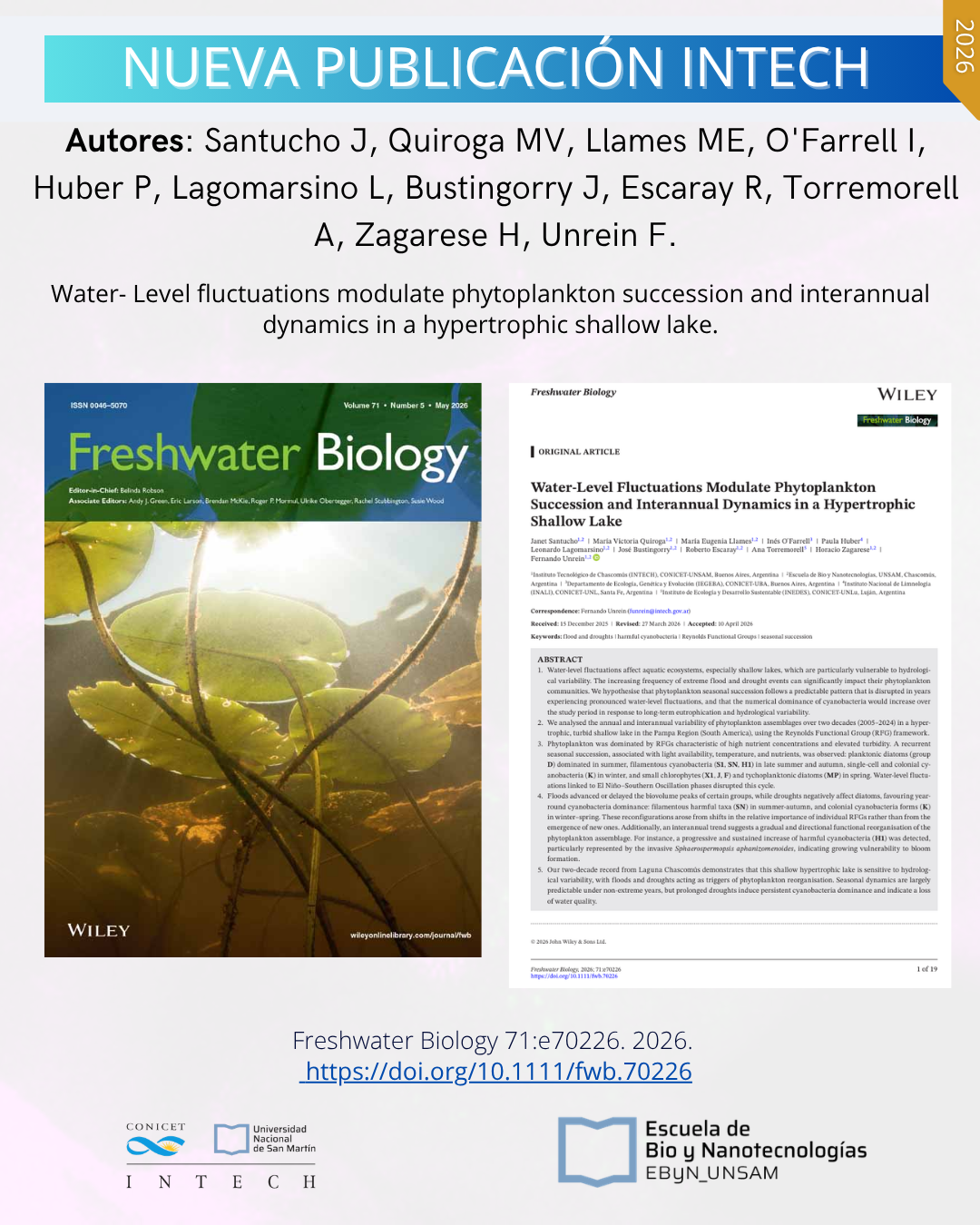
Freshwater Biology 71:e70226. 2026.
New publication: Water- Level fluctuations modulate phytoplankton succession and interannual dynamics in a hypertrophic shallow lake.
Water- level fluctuations affect aquatic ecosystems, especially shallow lakes, which are particularly vulnerable to hydrological variability. The increasing frequency of extreme flood and drought events can significantly impact their phytoplankton communities. We hypothesise that phytoplankton seasonal succession follows a predictable pattern that is disrupted in years experiencing pronounced water- level fluctuations, and that the numerical dominance of cyanobacteria would increase over the study period in response to long- term eutrophication and hydrological variability. We analysed the annual and interannual variability of phytoplankton assemblages over two decades (2005–2024) in a hyper trophic, turbid shallow lake in the Pampa Region (South America), using the Reynolds Functional Group (RFG) framework. Phytoplankton was dominated by RFGs characteristic of high nutrient concentrations and elevated turbidity. A recurrent seasonal succession, associated with light availability, temperature, and nutrients, was observed: planktonic diatoms (group D) dominated in summer, filamentous cyanobacteria (S1, SN, H1) in late summer and autumn, single- cell and colonial y anobacteria (K) in winter, and small chlorophytes (X1, J, F) and tychoplanktonic diatoms (MP) in spring. Water- level fluctuations linked to El Niño–Southern Oscillation phases disrupted this cycle. Floods advanced or delayed the biovolume peaks of certain groups, while droughts negatively affect diatoms, favouring year-round cyanobacteria dominance: filamentous harmful taxa (SN) in summer- autumn, and colonial cyanobacteria forms (K) in winter–spring. These reconfigurations arose from shifts in the relative importance of individual RFGs rather than from the emergence of new ones. Additionally, an interannual trend suggests a gradual and directional functional reorganisation of the phytoplankton assemblage. For instance, a progressive and sustained increase of harmful cyanobacteria (H1) was detected, particularly represented by the invasive Sphaerospermopsis aphanizomenoides, indicating growing vulnerability to bloom formation. Our two- decade record from Laguna Chascomús demonstrates that this shallow hypertrophic lake is sensitive to hydrological variability, with floods and droughts acting as triggers of phytoplankton reorganisation. Seasonal dynamics are largely predictable under non- extreme years, but prolonged droughts induce persistent cyanobacteria dominance and indicate a loss of water quality.