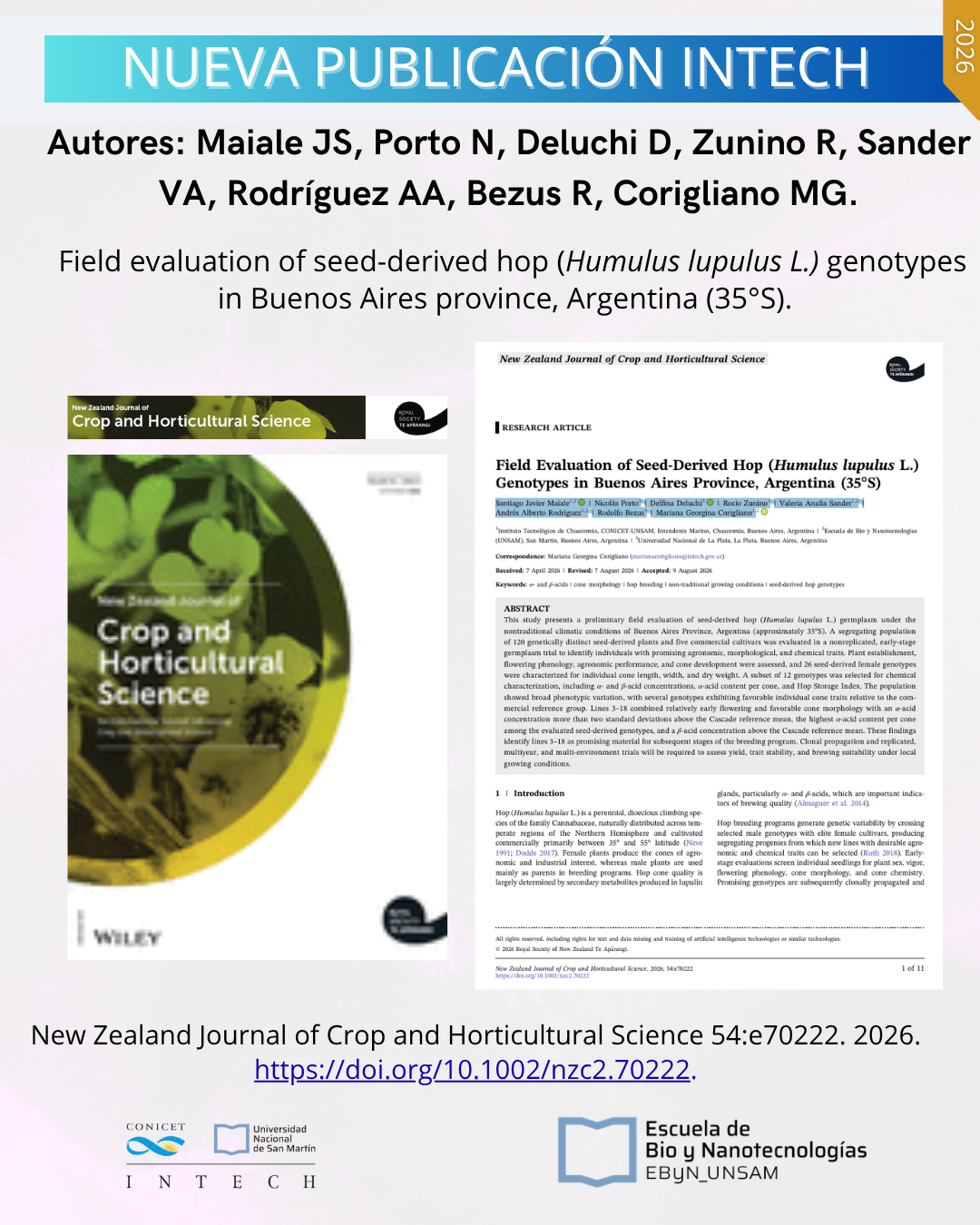
New Zealand Journal of Crop and Horticultural Science 54:e70222. 2026.
New publication: Field evaluation of seed-derived hop (Humulus lupulus L.) genotypes in Buenos Aires province, Argentina (35°S).
This study presents a preliminary field evaluation of seed-derived hop (Humulus lupulus L.) germplasm under the nontraditional climatic conditions of Buenos Aires Province, Argentina (approximately 35°S). A segregating population of 120 genetically distinct seed-derived plants and five commercial cultivars was evaluated in a nonreplicated, early-stage germplasm trial to identify individuals with promising agronomic, morphological, and chemical traits. Plant establishment, flowering phenology, agronomic performance, and cone development were assessed, and 26 seed-derived female genotypes were characterized for individual cone length, width, and dry weight. A subset of 12 genotypes was selected for chemical characterization, including α-andβ-acid concentrations, α-acid content per cone, and Hop Storage Index. The population showed broad phenotypic variation, with several genotypes exhibiting favorable individual cone traits relative to the commercial reference group. Lines 3–18 combined relatively early flowering and favorable cone morphology with an α-acid concentration more than two standard deviations above the Cascade reference mean, the highest α-acid content per cone among the evaluated seed-derived genotypes, and a β-acid concentration above the Cascade reference mean. These findings identify lines 3–18 as promising material for subsequent stages of the breeding program. Clonal propagation and replicated, multiyear, and multi-environment trials will be required to assess yield, trait stability, and brewing suitability under local growing conditions.