New publication: Tuning Optoelectronic Properties and PhotoelectrochemicalPerformance of β-TaON via Vanadium Doping
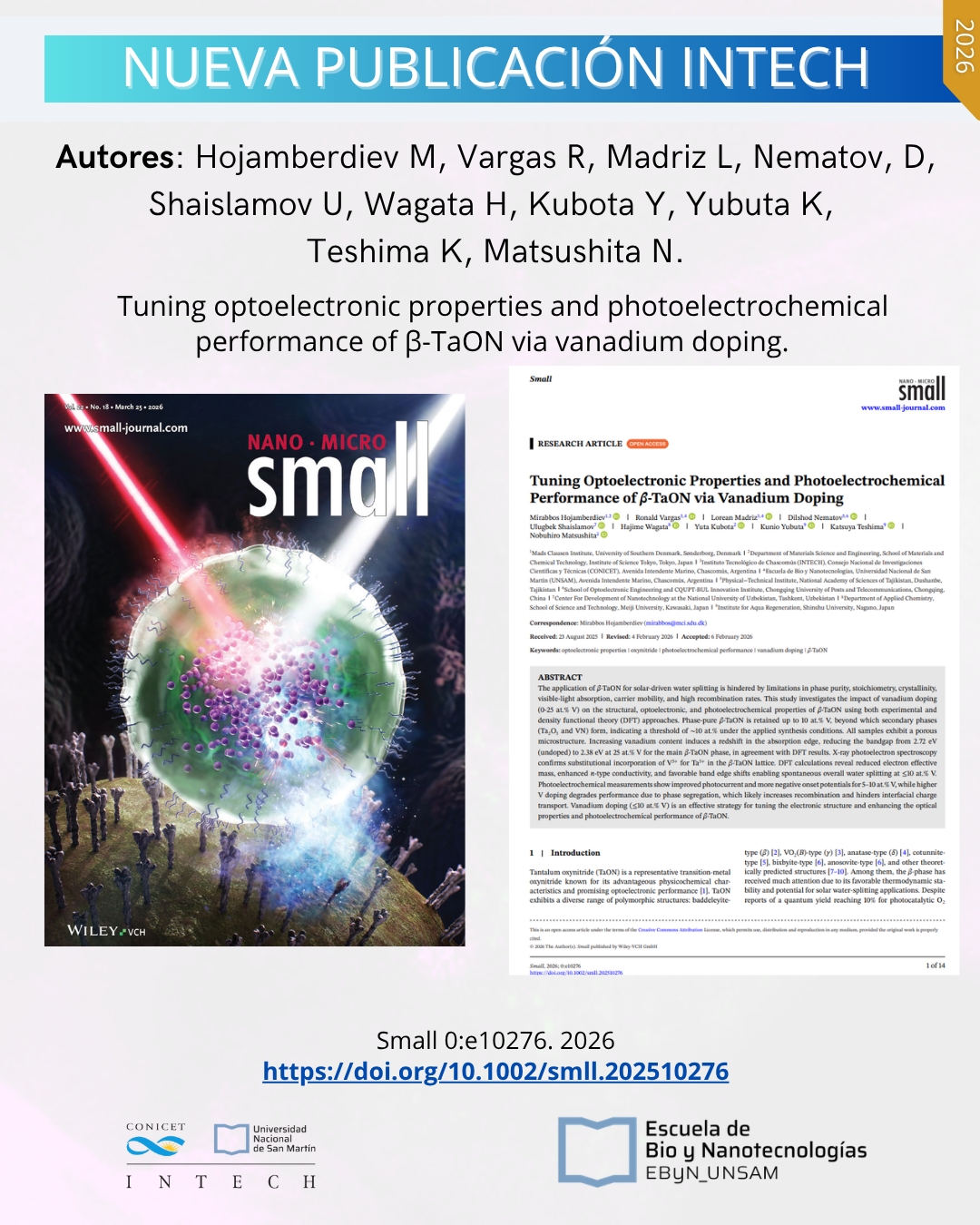
The application of β-TaON for solar-driven water splitting is hindered by limitations in phase purity, stoichiometry, crystallinity,visible-light absorption, carrier mobility, and high recombination rates. This study investigates the impact of vanadium doping(0-25 at.% V) on the structural, optoelectronic, and photoelectrochemical properties of β-TaON using both experimental anddensity functional theory (DFT) approaches. Phase-pure β-TaON is retained up to 10 at.% V, beyond which secondary phases(Ta2 O5 and VN) form, indicating a threshold of ∼10 at.% under the applied synthesis conditions. All samples exhibit a porousmicrostructure. Increasing vanadium content induces a redshift in the absorption edge, reducing the bandgap from 2.72 eV(undoped) to 2.38 eV at 25 at.% V for the main β-TaON phase, in agreement with DFT results. X-ray photoelectron spectroscopyconfirms substitutional incorporation of V5+ for Ta5+ in the β-TaON lattice. DFT calculations reveal reduced electron effectivemass, enhanced n-type conductivity, and favorable band edge shifts enabling spontaneous overall water splitting at ≤10 at.% V.Photoelectrochemical measurements show improved photocurrent and more negative onset potentials for 5–10 at.% V, while higherV doping degrades performance due to phase segregation, which likely increases recombination and hinders interfacial chargetransport. Vanadium doping (≤10 at.% V) is an effective strategy for tuning the electronic structure and enhancing the opticalproperties and photoelectrochemical performance of β-TaON.