Hydrobiologia 853, 1807–1827. 2026.
New Publication: Flooding events reshape bacterioplankton assemblages and functional properties in a hypertrophic Shallow Lake (Laguna Chascomús, Argentina)
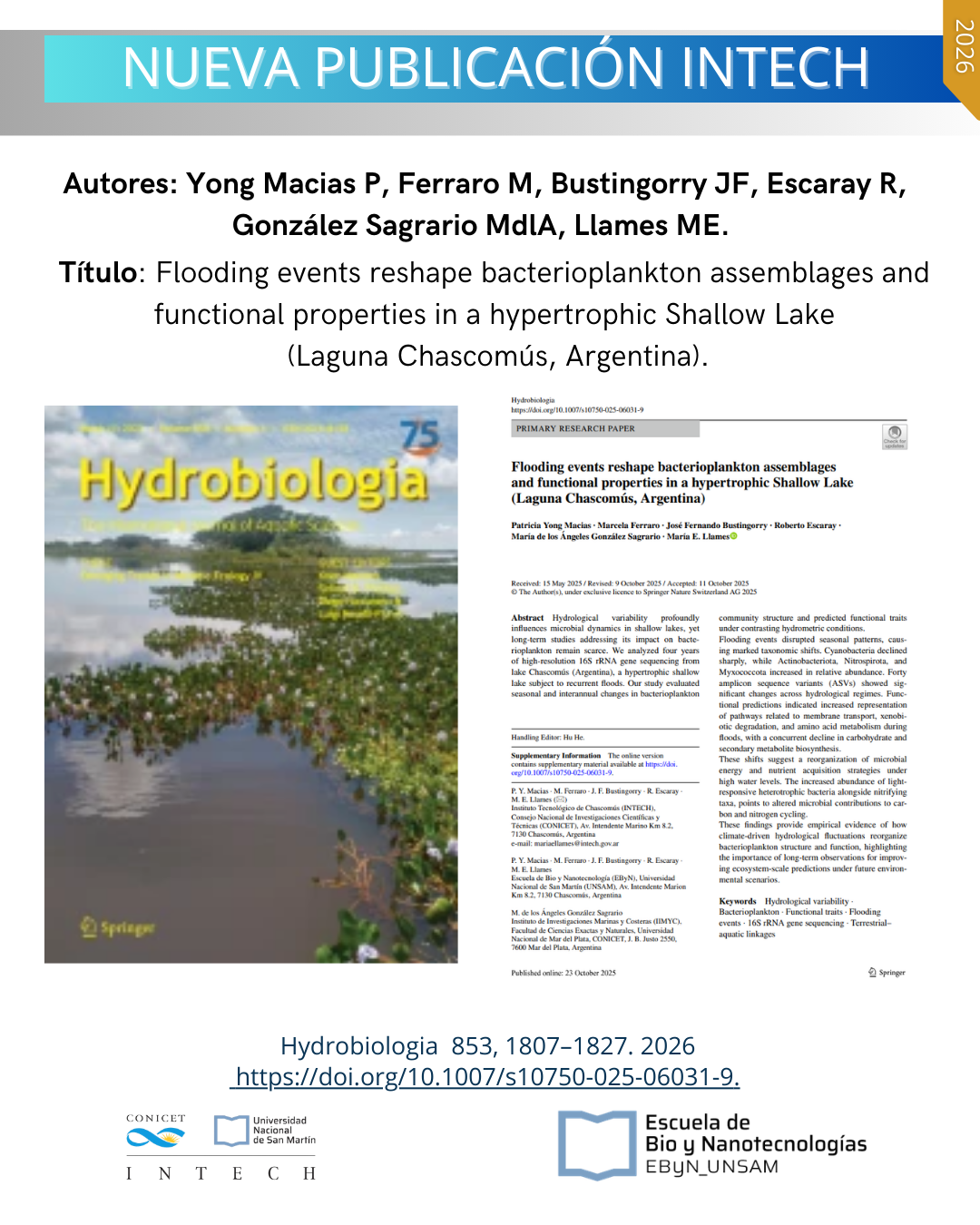
Hydrological variability profoundly influences microbial dynamics in shallow lakes, yet long-term studies addressing its impact on bacterioplankton remain scarce. We analyzed four years of high-resolution 16S rRNA gene sequencing from lake Chascomús (Argentina), a hypertrophic shallow lake subject to recurrent floods. Our study evaluated seasonal and interannual changes in bacterioplankton community structure and predicted functional traits under contrasting hydrometric conditions.
Flooding events disrupted seasonal patterns, causing marked taxonomic shifts. Cyanobacteria declined sharply, while Actinobacteriota, Nitrospirota, and Myxococcota increased in relative abundance. Forty amplicon sequence variants (ASVs) showed significant changes across hydrological regimes. Functional predictions indicated increased representation of pathways related to membrane transport, xenobiotic degradation, and amino acid metabolism during floods, with a concurrent decline in carbohydrate and secondary metabolite biosynthesis.
These shifts suggest a reorganization of microbial energy and nutrient acquisition strategies under high water levels. The increased abundance of light-responsive heterotrophic bacteria alongside nitrifying taxa, points to altered microbial contributions to carbon and nitrogen cycling.
These findings provide empirical evidence of how climate-driven hydrological fluctuations reorganize bacterioplankton structure and function, highlighting the importance of long-term observations for improving ecosystem-scale predictions under future environmental scenarios.
Yong Macias P, Ferraro M, Bustingorry JF, Escaray R, González Sagrario MdlA, Llames ME. Flooding events reshape bacterioplankton assemblages and functional properties in a hypertrophic Shallow Lake (Laguna Chascomús, Argentina). Hydrobiologia 853, 1807–1827. 2026. https://doi.org/10.1007/s10750-025-06031-9